Finally, We're Coming Together Against AI Data Center Energy Vampires
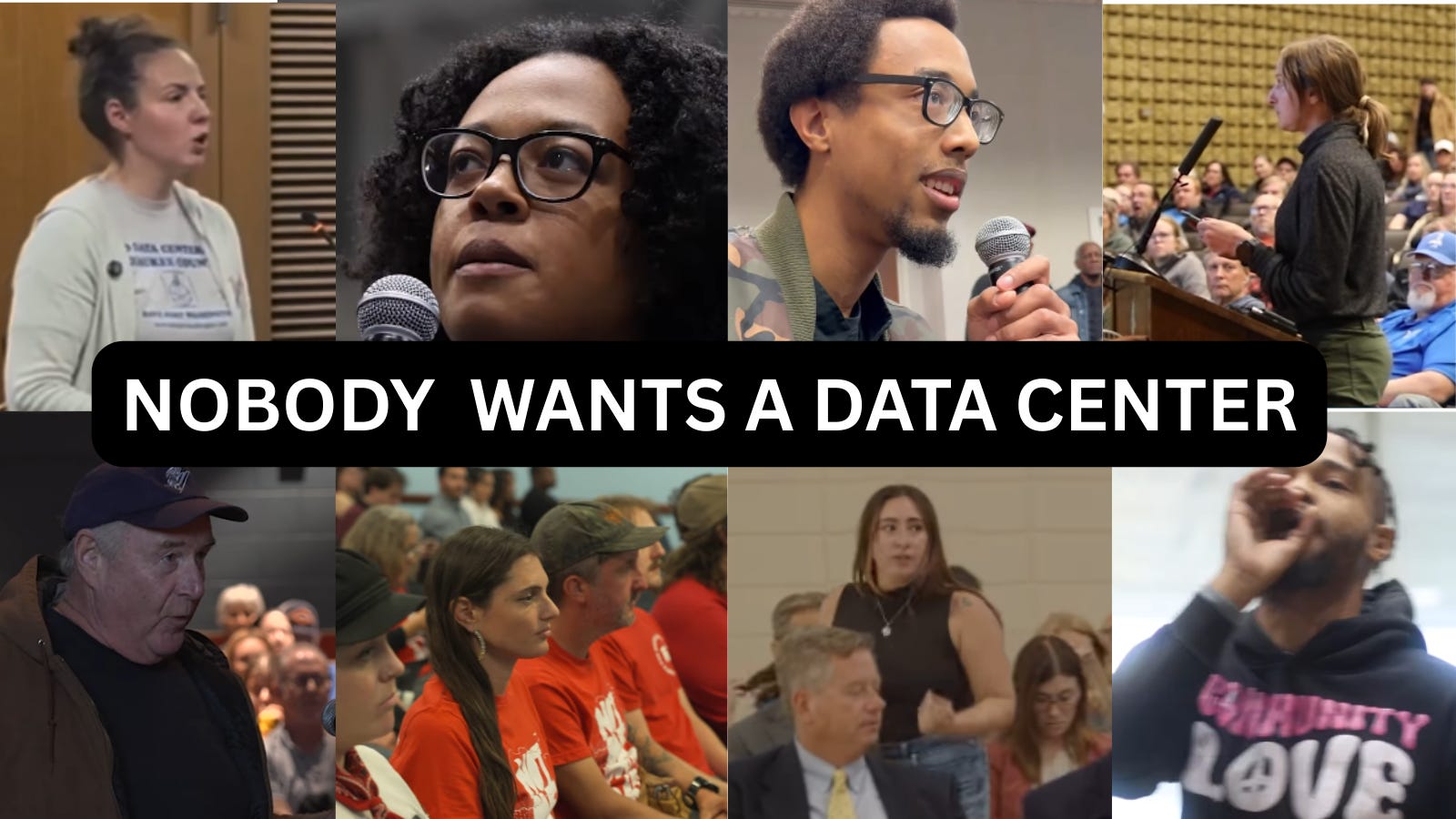
No one wants this development.
Lately, I’ve noticed a change in Americans’ approach to blocking harmful industrial development that I can’t praise enough: we’re developing a zone defense.
Whether a result of our rapidly expanding collective knowledge about how to effectively organize national, attention-grabbing protests or our heightened awareness of the abuse that comes with fast-tracked and unregulated energy extraction, I don’t know.
But the with the relentlessness of this Trump administration’s mission to cut red tape for extractive industries has come a much-needed response from activists that does three new things well:
It focuses just as much on collective protections as it does local ones.
It ties local land protections to national issues, like inequity and affordability.
It harnesses a feeling of citizen power, highlighting the expertise and activism of locals.
I think it’s so important to acknowledge what this response is, how it’s making news this week, and why it matters for our local livability and national political interests.
Quick background:
In the past, residents protesting energy industry development—like pipelines or fracking—have been derided as elitist. The criticism has been that these people seem to only care about environmental destruction because it is close to them, and that they would feel just fine if it were placed in another community.
The label the practice is given is Not In My Backyard, or NIMBY.
Critics argue that this practice of NIMBYism forces development out of areas that are privileged enough to know about threats and to be listened to when opposing them, at the expense of lower-income areas with fewer resources to push back.
While is a lot of nuance in that conversation, I have always felt that the criticism is deceptive when it comes to environmental protections. I think it’s fairer to blame the political system that takes advantage of people who can’t fight back and isolates those who are trying to do so.
But there are signs of a shift…
This year, with attacks on our public lands taking place across the country, more people from more places are taking part in public comments and petitions, even if they do not directly affect them.
I notice more local movements, sometimes in remote places that most people have never heard of, gaining national support. Scenes from community meetings are broadcast over social media and news outlets, and we’re learning about how others’ issues are tied to our own. Local protesters are upheld as heroes, and people all over the country outrage over abuses against them. It’s a “you-pick-on-one of-us-you-deal-with-all-of-us” vibe.
We are coming to recognize that any one place or person might represent our bigger ideals and may be a canary in the coal mine for bigger problems ahead.
Politically, coalitions of different stakeholder groups are coming together to fight for common interests in land protection in Congress, even if they don’t agree on many other things.
And these tactics are paying off. We’ve blocked deregulation and land sales in congressional legislation and won protections for local land and water, despite Trump’s opposing efforts.
Taking it to the next level with data centers
This year, residents are voicefully standing up and speaking out in tandem against AI data center development. Big battles in Michigan, Wisconsin, Missouri, Georgia, Ohio, Maryland, Kentucky, and Arizona are drawing crowds of passionate residents to packed public meetings.
Increased energy prices, irresponsible water consumption, light pollution, sound pollution, and lack of return on investment are just a few of the opposition points. Residents confidently pit their knowledge against those of institutional leaders and experts who assure them that data center development will be great for everyone.
This may sound small, but this shift in whose opinion is trusted (and not) is a great win for citizen power.
While some resident voices are ignored, increasingly, local officials are agreeing with them. It is becoming well-understood that data centers are unwelcome neighbors— no matter where they are placed.
One comment from a public meeting in Maryland particularly stood out to me. After resident speakers brought up issues of racial discrimination and environmental justice, one woman clarified her position:
“This is not just about Landover, although absolutely we’re saying no to Landover. It shouldn’t be in anyone else’s backyard. No one deserves an increase in their electric bills, their water bills.”
This is an important note, because we’re seeing a trend of data center developers kind of skipping from one location to another, just looking for a weakest link that will let them in. They are pushed out of one community, just to set up shop right next door.
As a result, people are looking out for their whole state and region, and trying to make the biggest changes possible to do so. Additionally, there’s a sort of pass-the-baton form of NIMBYism, where one community takes over when another runs out of jurisdiction. And advocates are sharing tactics along the way.
This week, 230 environmental groups responded to this ongoing fight and submitted to Congress a joint letter pressing for a moratorium on all AI data center construction until more regulations are put in place. The coalition includes national and local organizations, with interests ranging from environmental protections to food safety to human rights.
Recently in the House, Reps. Marcy Kaptur and Rashida Tlaib were among those speaking to the needs of people living near data center developments. Jim Costa introduced a bill for more research on impacts of big data centers to rural communities, and AOC secured a study on the impact of AI data centers on Americans’ electric bills.
“Do you like clean water coming out of your taps at affordable prices? So do I. You better hope a data center doesn’t get built near you. Do you like breathing clean air and being outdoors? I do. Organize like hell to keep these extremely loud data centers and their emissions out of your community.”
-Rep Rashida Tlaib
Just this year, Data Center Watch reported that 55% of Republican and 45% of Democratic representatives are positioning themselves against data center development.
Affordability—the catching issue of the day—is a key component of messaging against their development. It’s an important one, but I have a feeling that it’s not their only concern. We know AI data centers pose a threat to our environment, and more and more tech experts are warning about the rapid growth and usage of AI.
There are a lot of people caught in the net of anti-data centers.
What we do next
Wherever we live, we can oppose data centers. Whether there is an immediate threat of development in your community or not, you can bet that the construction of massive data centers across the country will impact your well-being.
It’s important to stay vigilant and take action with others early.
In your town, you can work with other advocates and your local government to prevent or prepare for the possibility of data center development coming to your town. Explore these 3 things:
Pass a memorandum to not look at building data centers for an allotted number of years.
Adopt an ordinance restricting or banning data centers
Change zoning so that data centers can only exist in industrial zones, far outside of residential areas.
Nationally, let your elected leaders know that you are against the rapid and unregulated development of AI data centers, and that you support research into its effects on Americans.
Environmentalism is intricately linked to affordability, and right now, Americans are understanding that connection in a whole new way.
It’s time to drive that point home. This is a battle that takes all of us, fighting from wherever we are to stop abuses against communities everywhere. If we do it right, we can build vital common political ground in the process.
With love and hope for the future,
Stephanie
Support from readers like you strengthens my work. If you want to help me fight for truth, land, and local voices—against Trump and others—please become a paid subscriber today:
Do you have experience with data center development coming to your city or state? What kind of citizen organizing do you see against it?
Learn more:
Opposition to data centers:
https://www.theguardian.com/us-news/2025/dec/08/us-data-centers
https://www.foodandwaterwatch.org/wp-content/uploads/2025/12/National-Data-Center-Moratorium.pdf
https://www.datacenterwatch.org/report
https://thehill.com/policy/technology/5605667-data-center-criticism-study/
Little background on NIMBYism:
Look at Data Centers in communities:


Bravo peeps. Now about housing...
Data centers suck. Water, energy, the life out of the air and our communities. I don’t need ai that bad.